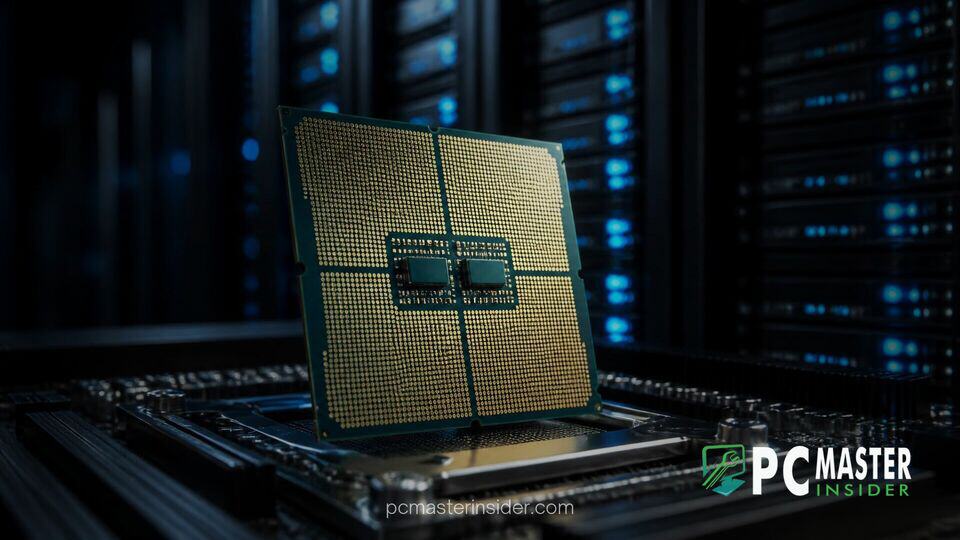
AMD has officially announced its 6th Generation EPYC server processor family, delivering massive compute density upgrades with flagship chips scaling up to 256 cores and 512 threads per socket. Built on the new Zen 6 core architecture, the lineup introduces next-generation system platforms designed to power intensive cloud computing, enterprise software, and artificial intelligence infrastructure.
The latest silicon generation doubles memory bandwidth and expands input and output capacity across single and dual-socket enterprise server builds. Server vendors including Dell, HPE, Lenovo, and Supermicro are actively preparing commercial platforms around the new processor architecture.
AMD 256 Core EPYC Server Processors Drive Next-Level Compute Density
The introduction of high-density amd 256 core epyc server processors marks a significant leap in x86 execution thread count, moving far beyond the 192-core threshold set by the previous 5th Gen EPYC 9005 family. By packing up to 256 execution cores into a single physical CPU socket, data center operators can run significantly more virtual machines, cloud containers, and parallel workloads per server rack while maintaining strict space constraints.
At the center of this product expansion is the Venice SP7 platform. Designed specifically for high-capacity enterprise environments, Venice SP7 supports up to 16 channels of DDR5 memory and features full compatibility with high-speed MRDIMM modules. This structural redesign delivers up to 1.6 TB/s of aggregate memory bandwidth per processor, eliminating long-standing data bottlenecks in large-scale database clusters and machine learning tasks.
Architecture Specifications and Compute Density Improvements
The new 6th Gen EPYC lineup leverages advanced fabrication nodes to house both standard high-frequency Zen 6 cores and dense throughput-optimized Zen 6c cores within the same architectural ecosystem. While high-frequency variants achieve boost speeds reaching 5.3 GHz for latency-sensitive applications, the dense Zen 6c models concentrate maximum compute power into tight thermal envelopes up to 600W TDP.
System bus interconnects have also seen an overhaul. The SP7 platform debuts native support for PCIe Gen 6 and CXL 3.1 connectivity. PCIe Gen 6 effectively doubles per-lane bandwidth compared to PCIe Gen 5 lanes used in legacy server motherboards, allowing fast data exchanges with next-generation accelerators, network interface cards, and high-speed NVMe storage arrays.
Platform advances in memory subsystem handling run parallel to hardware efficiency initiatives across the industry. Software solutions like AMD AI-predictive memory management are increasingly used to optimize resource usage in memory-constrained cloud nodes alongside higher physical memory channel counts. Furthermore, Winbond expanding its memory lineups across complementary embedded deployments reflects the broader hardware push toward handling dense data streams efficiently.
Competitive Impact Against Intel and Nvidia Server Platforms
AMD's focus on x86 socket performance challenges both core CPU competitors and hardware accelerator vendors. By scaling per-socket compute power, AMD aims to keep business-critical workloads anchored to x86 platforms without requiring specialized GPU accelerators for routine enterprise inference tasks.
The push for core density coincides with shifts across the semiconductor industry. Recently, news emerged regarding Intel shifting CPU production capacity to server chips to satisfy enterprise demand, emphasizing the intense competition for server socket market share. AMD claims its flagship 256-core EPYC 9996 offers substantial performance leads over competing x86 chips in workloads such as GROMACS simulations, AES encryption, and high-concurrency database queries.
Security enhancements remain a primary selling point for enterprise buyers evaluating infrastructure upgrades. The 6th Gen EPYC family incorporates hardware-level protections against emerging threats, complementing broader industry efforts like recent updates where Intel and AMD issued security updates covering server firmware and hardware vulnerabilities. Operating system developers are also optimizing kernel layers to handle high-core architectures, similar to how Microsoft integrated Intel APX support into recent Windows builds to improve instruction execution on modern chips.
Market Availability and Enterprise Deployment Timelines
Initial server systems powered by AMD 6th Gen EPYC 9006 Series SP7 processors are currently shipping from leading original equipment manufacturers (OEMs) and system integrators. Cloud service providers, including Microsoft Azure and Oracle Cloud Infrastructure, are slated to roll out public cloud instances based on the 256-core processors over the coming months.
AMD has also confirmed that additional variations of the platform, including the enterprise-focused SP8 socket models and specialized memory-optimized options, will expand global hardware availability into early 2027.
With massive thread counts, doubled memory channels, and PCIe Gen 6 throughput, AMD's expanded EPYC portfolio provides data center architects with powerful tools to consolidate server hardware, reduce overall operational expenditures, and meet growing compute demands.