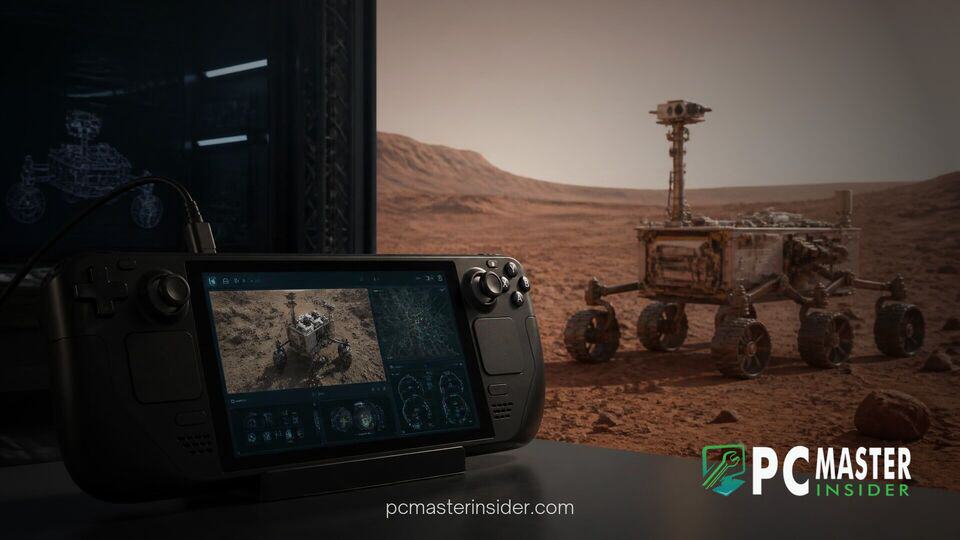
Aerospace engineers at Airbus facilities in the United Kingdom are utilizing Valve's handheld gaming PC, the Steam Deck, to pilot prototype planetary rovers during ground trials. The compact hardware acts as a portable command unit while engineers test mobility and navigational systems in simulated Martian environments.
While the final Rosalind Franklin ExoMars rover will operate autonomously on Mars, direct manual control remains essential during its development phase on Earth. By adopting a commercial off-the-shelf Linux handheld, Airbus engineers have found an accessible alternative to bulky laptops and custom control interfaces.
Airbus Integrates Valve Steam Deck into ExoMars Rover Field Testing
The unusual hardware implementation came to light during a visit to Airbus UK facilities featured in a video by science popularizer Tom Scott. During the facility tour, engineers demonstrated how the prototype ExoMars rover responds to movement commands. While early testing stages relied on traditional laptop terminals to send directional instructions, engineers later transitioned to a Valve Steam Deck running custom control software.
By taking advantage of the integrated analog thumbsticks, physical face buttons, and rear triggers, operators gained real-time manual control over the multi-wheeled prototype as it navigated simulated Martian terrain. Rather than acting as the primary computing core of the vehicle, the Steam Deck serves strictly as an ergonomic handheld interface linked to the rover's local control system.
How Engineers Adapt Handheld PC Hardware for Aerospace Testing
The Rosalind Franklin rover, developed by Airbus for the European Space Agency (ESA), is built to explore the surface of Mars with high operational autonomy. Due to the immense distance between Earth and Mars, radio signals take several minutes to travel back and forth, making real-time telemetry and remote driving impossible during mission execution. On Mars, the rover will rely heavily on its onboard 3D navigation cameras and automated pathfinding algorithms to plan its route safely.
However, during initial terrestrial field testing in the UK, direct operator intervention is required constantly. Engineers must regularly adjust trajectories, evaluate suspension responses, and verify wheel traction on various soil compositions. In these scenarios, lugging high-powered laptops or setting up bulky ground station consoles can hinder engineers who need to move alongside the machine. The Steam Deck provides an all-in-one package with a bright display, built-in gamepad controls, wireless connectivity, and an internal battery, enabling rapid deployment in field conditions.
Crucially, the Steam Deck runs SteamOS, an open-source operating system based on Arch Linux. This open architectural architecture allows software developers and engineers to easily deploy custom Linux binaries, telemetry dashboards, and proprietary control software without facing the strict software lockouts common to standard home console consoles. Those interested in similar PC ecosystem developments can check how SteamOS dev branches add native driver support for broader hardware compatibility.
Advantages of Off-the-Shelf Gaming Controllers for Robotics
Using gaming controllers for complex machinery is an increasingly common trend across defense, aerospace, and robotics sectors. Video game controllers offer refined ergonomics honed over decades of consumer testing, allowing operators to manipulate complex hardware intuitively with minimal training.
For research teams and prototype developers, commercial off-the-shelf hardware drastically reduces costs and development timelines. Designing, prototyping, and manufacturing a custom ruggedized handheld controller with integrated screens and buttons can require hundreds of thousands of dollars in engineering budgets. Repurposing a mass-produced consumer PC yields an reliable, ergonomic solution at a fraction of the cost, freeing up resources for core flight systems.
This is far from the first instance of Valve's portable hardware stepping into industrial applications. Operators at Disney parks have previously been spotted using Steam Decks to control free-roaming BDX droids at Star Wars: Galaxy's Edge. Furthermore, modders and hardware enthusiasts frequently repurpose Valve devices for specialized tasks, much like how users fix Steam secondary launcher issues when tuning their personal gaming rigs.
Future Prospects for Handheld PC Hardware in Industrial Use Cases
As portable PC hardware matures, the line between consumer electronics and professional field equipment continues to blur. Handheld devices offering high compute density, versatile input options, and open software platforms are becoming valuable tools for field engineers, drone operators, and robotics technicians.
While the Steam Deck will not be traveling to Mars aboard the final ExoMars lander, its role in ground testing demonstrates the utility of flexible consumer hardware in high-tech testing environments. As commercial handheld devices become even more capable, engineering firms are likely to expand their use of off-the-shelf gaming hardware for field operations, remote inspection systems, and mobile robotics control.