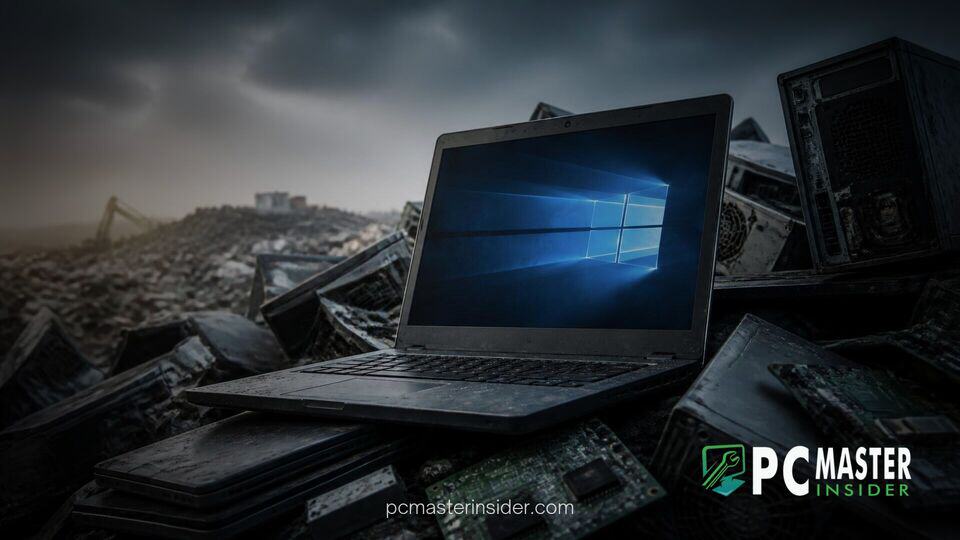
Consumer advocacy groups and environmental organizations are raising concerns over Microsoft's operating system strategy, warning that ending official support for Windows 10 could trigger an unprecedented surge in digital refuse. Research highlights that hundreds of millions of functional personal computers are unable to meet the system requirements for Windows 11, leaving owners with limited choices.
According to findings from the Public Interest Research Group (PIRG), up to 400 million of the estimated installed base of Windows 10 devices cannot be upgraded officially. As standard security updates cease, millions of operational laptops and desktops face premature retirement, creating severe ecological and economic ripple effects across the global technology supply chain.
Windows 10 end of support e-waste risk threatens environmental goals
The impending disruption centers on the strict system requirements introduced with Windows 11. Microsoft mandated specific security hardware components, including Trusted Platform Module (TPM) version 2.0, UEFI Secure Boot capability, and a restricted list of supported modern processors. While these hardware baselines were designed to enhance system-level security, they effectively locked out millions of computers manufactured prior to 2018, despite those machines possessing adequate processing power and RAM for daily computing tasks.
PIRG Warning Highlights Impending PC E-Waste Surge
In its Electronic Waste Graveyard report, PIRG outlined how the software lifecycle timeline forces consumer obsolescence. The group noted that abandoning standard patch distribution for Windows 10 leaves hundreds of millions of active devices vulnerable to emerging security threats. Because many businesses and individual users cannot risk operating unsecured software, functional machines will likely be scrapped in favor of new purchases.
PIRG directors pointed out that this transition represents one of the largest instances of software-driven planned obsolescence in recent history. Rather than failing due to physical breakdown or worn components, machines are rendered obsolete strictly by central software policy decisions.
Strict Windows 11 Hardware Limits Locking Out Working PCs
Market research estimates vary, but the consensus points toward massive displacement. While industry analyst firm Canalys previously estimated that 240 million devices would become e-waste, broader consumer data compiled by advocacy groups like PIRG pushes that estimate closer to 400 million machines worldwide.
Many of these machines reside in school districts, non-profit organizations, and small businesses that lack the capital budgets needed for fleet-wide hardware replacement. Because the secondary market relies heavily on official operating system support for refurbishing and resale, unsupported machines lose almost all commercial resale value, severely disrupting circular economy channels.
Environmental Consequences of Upgrading Standard Hardware
The physical footprint of discarding hundreds of millions of personal computers presents a severe environmental challenge. Electronic waste remains the fastest-growing solid waste stream globally, driven by short product lifecycles and limited recycling infrastructure.
Estimated 1.6 Billion Pounds of Discarded Electronics
Advocacy calculations indicate that scrapping 400 million personal computers would yield approximately 1.6 billion pounds (around 700 million kilograms) of electronic waste. When disposed of improperly in municipal landfills, electronic components can leach toxic heavy metals, such as lead, mercury, and cadmium, into surrounding soil and groundwater systems.
Furthermore, manufacturing replacement computers requires significant energy, rare earth metals, and chemical processing. Research indicates that up to 80 percent of a personal computer's total lifetime carbon emissions occur during the manufacturing phase rather than during active operation. Prematurely replacing working hardware significantly increases the overall carbon footprint of personal computing.
Potential Solutions for Windows 10 Holdouts and Extended Support
To mitigate security risks for users unable to upgrade immediately, Microsoft introduced its Extended Security Updates (ESU) program for Windows 10. Historically reserved strictly for enterprise clients, the ESU program allows both commercial and individual users to purchase annual security patches for a specified duration.
However, advocates argue that paid security extensions simply delay the problem while placing an additional financial burden on consumers. Alternative options gaining attention include switching older hardware to lightweight Linux distributions or cloud-centric platforms like ChromeOS Flex, which can run securely on older processors without requiring TPM 2.0 chips.
The situation has energized right-to-repair and environmental campaigns globally. Coalition groups continue to petition software vendors to extend default security support for functional operating systems, emphasizing that sustainable digital policy must prioritize hardware longevity alongside software innovation.