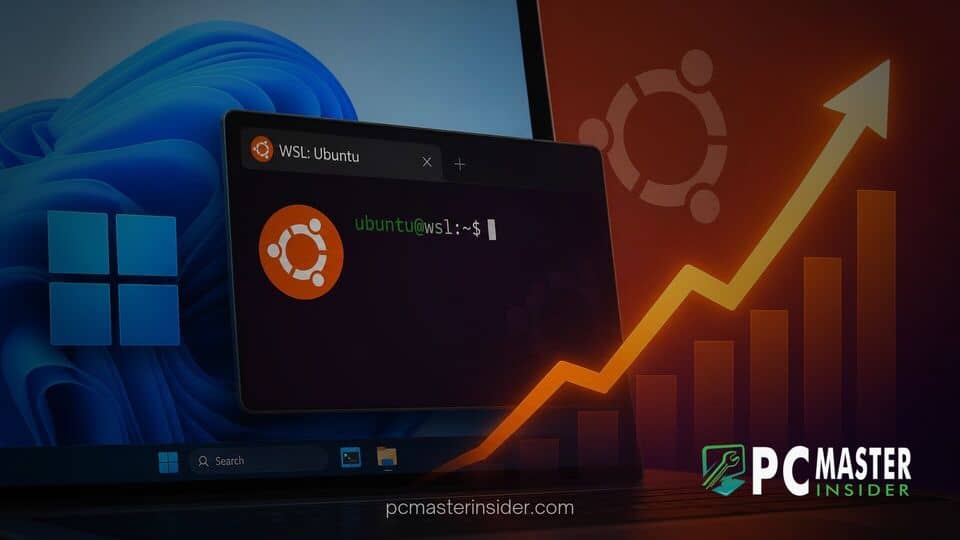
Canonical has reported that the adoption of Ubuntu running via Windows Subsystem for Linux on Windows 11 is now expanding at a significantly faster rate than native bare-metal desktop installations. The surge highlights a major shift in enterprise software engineering and cross-platform application development workflows globally.
As Windows 11 adoption matures across corporate environments, software developers are increasingly relying on integrated virtualized environments to access Linux command-line tools without leaving their primary desktop operating system.
Canonical Highlights Rapid Growth of Ubuntu on Windows 11 WSL
Canonical, the publisher behind Ubuntu, revealed recent metrics demonstrating that monthly active instances of Ubuntu on Windows Subsystem for Linux have seen double-digit percentage growth year over year. In contrast, standard desktop deployments on dedicated PC hardware continue to grow at a steady but modest pace. While total bare-metal Ubuntu desktop installations still maintain a large existing user base, the trajectory of user onboarding on Windows 11 indicates that virtualized Linux usage inside Microsoft's ecosystem could soon become the primary entry point for developers using Canonical's distribution.
WSL User Base Expected to Surpass Native Desktop Installs
Industry analysts project that if the current Ubuntu on Windows 11 WSL growth momentum continues, the active installation count for Linux under WSL could surpass dedicated native desktop installations within the coming quarters. This trend is driven heavily by corporate IT policies that standardize on Windows 11 laptops for hardware provisioning while requiring Linux environments for backend web engineering, containerized services, and cloud application deployment.
Key Drivers Behind the Linux Subsystem Adoption Surge
The rapid expansion of Ubuntu on Windows 11 WSL growth is primarily fueled by continuous architectural improvements made to Windows Subsystem for Linux version 2. Unlike early iterations that relied on translation layers, modern WSL 2 utilizes a lightweight hypervisor running a real Linux kernel. This architectural foundation provides near-native file system execution speed, full system call compatibility, and direct system resource access.
Furthermore, recent updates to Windows 11 have streamlined the installation process. System administrators and developers can deploy a fully functional Ubuntu distribution with a single terminal command. Graphical user interface support through WSLg has also enabled seamless execution of Linux desktop applications alongside native Windows programs, eliminating the friction historically associated with dual-boot configurations or resource-heavy virtual machines.
AI and Machine Learning Development on Windows Hardware
Another major accelerator for Ubuntu on Windows 11 WSL growth is the surge in local artificial intelligence and machine learning development. Modern data science toolchains, framework libraries, and neural network repositories rely heavily on Linux environments for package compatibility and hardware acceleration driver support.
Through direct GPU passthrough features supported in Windows 11 and WSL 2, developers can leverage high-performance graphics hardware directly within an Ubuntu terminal. This capability allows software engineers to build, train, and test AI models locally on Windows workstations using native Linux commands, bypassing the complex environment configuration steps previously required on host operating systems.
Impact on Microsoft Ecosystem and Developer Workflows
The operational synergy between Canonical and Microsoft represents a fundamental change in desktop operating system dynamics. Rather than competing directly for host desktop hardware market share, both organizations have aligned their software offerings to capture the modern developer desktop market. Microsoft retains corporate hardware and endpoint management consistency with Windows 11, while Canonical expands its enterprise ecosystem reach by embedding Ubuntu directly into developer workstations.
Enterprise IT departments report higher productivity and simplified device management as a result of this integration. Corporate network administrators can maintain strict security policies, domain controls, and hardware compliance guidelines using standard Windows 11 management utilities while enabling developers to operate inside standard Ubuntu terminal environments. This balance reduces the operational overhead of supporting heterogeneous endpoint fleets containing mixed hardware configurations.
Looking ahead, Canonical plans to deepen its cooperation with Microsoft to further optimize system resource allocation, container integration, and enterprise licensing management for Ubuntu on Windows Subsystem for Linux. As hybrid software development environments become standard practice across enterprise organizations, the integration between Windows 11 and Ubuntu is poised to remain a dominant framework for contemporary developer workstations.