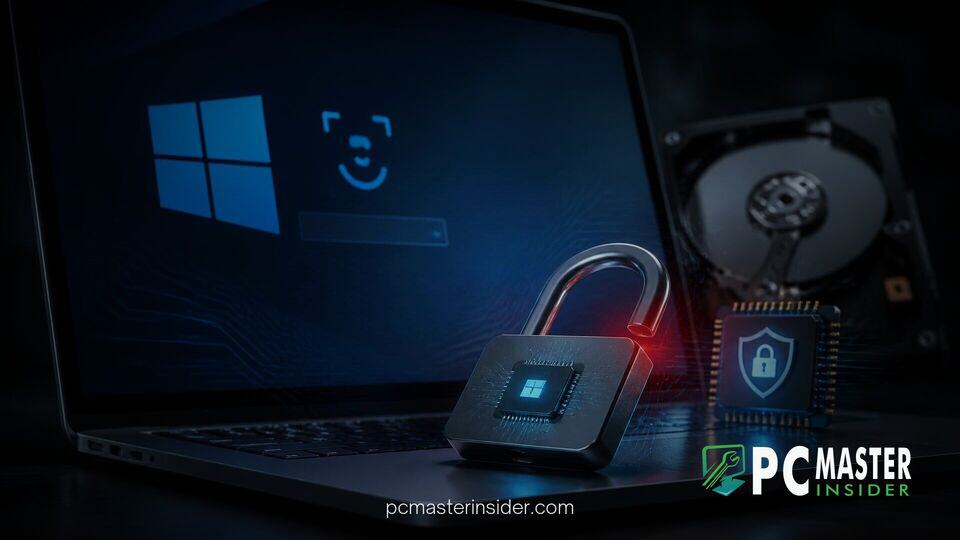
Security researchers have uncovered a physical attack technique that circumvents the hardware anti-hammering counters built into modern Trusted Platform Modules. By resetting the chip's internal failure counter, attackers can bypass security throttles to rapidly brute-force short PINs used by Windows Hello and BitLocker.
The vulnerability exposes systems relying on default four-digit or six-digit personal identification numbers to automated dictionary attacks. Under normal conditions, a TPM enforcing anti-hammering protocols introduces exponential delays or total lockouts after a small number of incorrect login attempts. However, hardware manipulation allows unauthorized actors to reset these retry counters repeatedly, turning a process that would typically take years into one executed in just a few days.
tpm lockout bypass flaw windows hello bitlocker
The discovered flaw undermines the foundational security mechanisms intended to safeguard encrypted drives and local authentication tokens. By abusing low-level hardware communication interfaces, physical attackers can continuously force the module into clearing its failed attempt record, leaving system protection mechanisms open to automated guessing attacks.
TU Berlin Researchers Discover Firmware TPM Reset Flaw
The hardware research team at Technische Universität Berlin (TU Berlin) identified the firmware mechanism that allows the lockout state to be repeatedly erased. Their investigation revealed that manipulating specific non-volatile storage components, such as external flash memory modules or internal firmware registers, forces the security chip to drop its lockout counter without wiping stored encryption secrets.
Rather than triggering a self-destruct or wiping master keys, the module accepts reset routines or reverts to an uninitialized counter state upon power-cycling under controlled electrical conditions. This behavior violates the architectural expectations of the Trusted Computing Group (TCG) specification, which mandates that authorization attempt counters survive unexpected resets and power interruptions.
How Physical Access Enables Rapid PIN Brute-Forcing
Exploiting the vulnerability requires physical access to the target machine, specialized hardware tools, and logic analyzers. An attacker opens the system chassis and connects directly to the Serial Peripheral Interface (SPI) or Inter-Integrated Circuit (I2C) bus linking the system board to the flash storage. By intercepting communication signals or injecting custom commands during boot, the hardware tool systematically triggers PIN authorization queries while resetting the failure counter immediately after every failed attempt.
Because standard Windows configurations rely on short alphanumeric or numerical PINs for everyday convenience, the attack vector drastically shortens cracking timelines. While standard TPM exponential backoff rules lock devices for hours or days after limited bad inputs, resetting the chip lets automated microcontrollers try thousands of combinations every hour. Organizations relying on short PINs for Windows Hello PIN setup update routines face heightened exposure if devices are stolen or left unattended.
Affected Processors and Firmware Patch Timelines
The issue spans several motherboard implementations and platform security architectures, particularly affecting systems using discrete TPM chips or specific firmware-based TPMs (fTPM) across modern AMD and Intel platforms. Systems relying on specialized flash chips with Replay Protected Memory Block (RPMB) features may also remain vulnerable if the firmware does not properly handle counter synchronization upon unexpected resets.
Hardware vendors and silicon manufacturers are reviewing firmware release updates to resolve the counter persistence failure. However, patching physical bus manipulation risks across millions of fielded enterprise and consumer devices presents significant deployment challenges. System operators managing remote endpoints can leverage enterprise management suites, similar to updates made when IT administrators consolidated Windows Autopatch quality update policies in Intune, to evaluate overall system integrity across fleets.
Recommended Security Mitigations for System Administrators
Until full microcode updates roll out to all impacted motherboards, security analysts recommend several immediate defensive configurations:
- Increase PIN Complexity: System administrators should configure Group Policy to enforce longer PIN lengths. Upgrading from a 4-digit PIN to an 8-digit or 10-digit alphanumeric passphrase increases the search space exponentially, making brute-force attempts impractical even if lockout counters are routinely reset.
- Deploy Enhanced BitLocker Authentication: Organizations using BitLocker full-disk encryption should mandate a combination of TPM authentication alongside long pre-boot passphrases or external USB startup keys.
- Restrict Physical Physical Access and Enable Device Tracking: IT administrators can leverage policy controls, such as testing an Intune Remote Lock feature on Windows 11, to instantly render lost devices unusable while enforcing strict physical chassis security measures.
- Audit Baseline Configurations: Enterprises should verify endpoint policies via modern compliance tools like the Windows Baseline Protection preview to maintain rigorous security baselines across remote corporate hardware.
As physical attacks against boot-level components continue to evolve, relying solely on hardware security modules without enforced passphrase complexity leaves endpoints exposed. Maintaining strong PIN length policies and auditing physical hardware protections remains essential to keeping data secure against dedicated offline attacks.