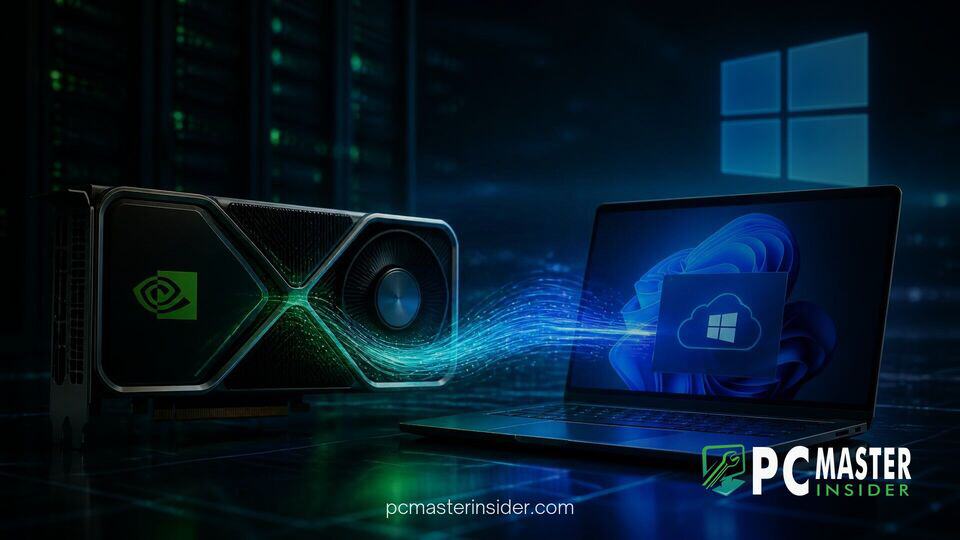
Nvidia and Microsoft have officially announced a strategic partnership to bring high-performance Direct Stream technology to GPU-accelerated Windows 365 Cloud PCs. Announced during Microsoft Ignite 2026, the collaboration aims to drastically reduce streaming latency and deliver workstation-grade graphical fidelity over virtual desktop sessions.
By leveraging custom streaming protocols and server-side GPU encoding optimizations, the new technology ensures enterprise users running graphic-heavy workflows experience responsiveness identical to a local physical PC.
Nvidia Direct Stream Integration for Cloud PCs
The core objective of integrating Nvidia Direct Stream with Windows 365 Cloud PCs is to eliminate traditional bottlenecks associated with remote desktop protocol (RDP) video encoding. Rather than relying entirely on CPU-based rasterization or basic virtual display drivers, Direct Stream links directly into the hardware video encoding pipelines of host GPUs. This bypasses intermediary processing steps inside host hypervisors, significantly lowering frame capture and delivery overhead.
As enterprise cloud adoption moves beyond typical office applications into real-time 3D rendering, computer-aided design (CAD), video editing, and complex data visualization, cloud workstations require native-like frame pacing. Nvidia and Microsoft designed this architecture to maintain persistent frame delivery even when streaming over challenging or constrained enterprise networks.
Dual 4K Display Support and Latency Optimization
Under the new protocol specs, Direct Stream natively supports up to two simultaneous 4K displays streaming at 60 frames per second. In addition to high resolutions and smooth refresh rates, the technology introduces full 4:4:4 equivalent color accuracy. Standard remote desktop setups typically compress color spaces down to 4:2:0 chroma subsampling to preserve bandwidth, which often leads to color bleeding, blurry text, and distorted fine details. Full 4:4:4 color support ensures sharp text rendering and accurate color representation for visual creators and software engineering teams.
Server-side encoding is powered by Nvidia RTX PRO 6000 Blackwell Server Edition GPUs optimized specifically for low-overhead video compression. On the network front, Direct Stream incorporates dynamic bandwidth adaptation algorithms that adjust streaming quality on the fly, preventing input lag and visual stutter during network congestion.
Expanding Local AI Workloads on RTX Spark PCs
This streaming advancement arrives alongside Microsoft and Nvidia expanding hardware options across hybrid environments. Earlier hardware collaborations brought RTX Spark platform hardware to market, enabling compact desktops and laptops to process massive localized AI computing workloads. Modern enterprise environments increasingly mix local accelerated PCs with cloud-hosted virtual desktops.
To keep system security aligned with these complex multi-desktop configurations, Microsoft has been bolstering endpoint protections. The software giant recently launched the Windows Endpoint Security Platform GA to shift security agents out of kernel mode, alongside previewing Windows Baseline Protection to unify security policies across hybrid infrastructure.
Furthermore, as autonomous AI agents begin executing tasks across cloud workspaces, security remains top of mind. Microsoft recently detailed Microsoft Execution Containers to isolate automated processes and safeguard enterprise endpoints from unintended system actions. Combining isolated execution environments with Nvidia Direct Stream enables secure, high-speed remote interaction for both human workers and autonomous digital assistants operating within Windows 365 for Agents.
Availability and Preview Schedule for Enterprise Users
Organizations interested in testing the high-performance streaming capabilities can sign up for an early limited preview program immediately. Microsoft and Nvidia confirmed that a broader public preview of Direct Stream for GPU-accelerated Cloud PCs is scheduled for early 2027.
When deployed at scale, enterprise administrators will be able to provision Direct Stream configurations directly via Microsoft Intune and the Microsoft 365 admin center without requiring complex client-side driver installations on end-user endpoints.
The collaboration highlights a continued push by Nvidia and Microsoft to blur the performance gap between cloud virtual machines and local physical hardware, bringing fluid visual workstation performance to remote workforces globally.