
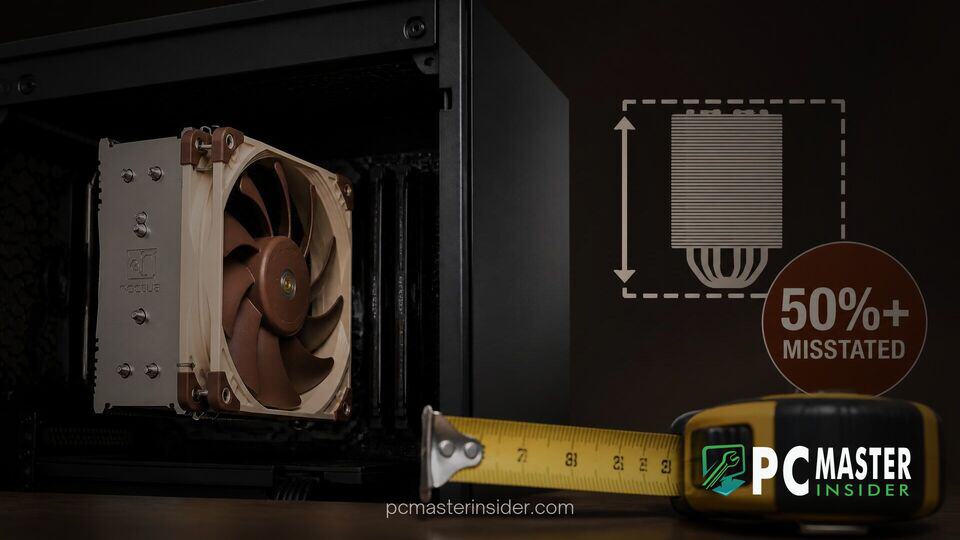
Cooling specialist Noctua has published findings from an internal compatibility testing program, revealing that more than half of the PC cases it evaluated featured inaccurate CPU cooler clearance specifications. After physically taking measurements across more than 100 chassis models, the company discovered significant discrepancies between advertised maximum cooler heights and real-world dimensions.
Out of the tested sample size, 56 cases exhibited measurable deviations from the manufacturer specifications listed on official product pages. The recorded errors ranged from offering 3.5 millimeters less clearance than advertised to providing up to 10 millimeters of additional unlisted headroom.
Noctua PC Case CPU Cooler Clearance Study Shows Widespread Discrepancies
The Noctua PC case CPU cooler clearance study highlights a persistent issue for custom PC builders who rely on precise manufacturer data. According to Noctua, the investigation was prompted by customer inquiries regarding discrepancies between the official case specs and Noctua's own compatibility database. To ensure component fitment accuracy, the Austrian cooling vendor began manually measuring popular market enclosures rather than relying solely on published spec sheets.
The results show that inaccurate measurements occur across a wide variety of form factors, affecting small form factor (SFF) enclosures as well as traditional mid-tower and full-tower designs. While extra space is generally a welcome surprise for builders, overstating available clearance creates major installation bottlenecks.
Noctua Compatibility Testing Uncovers Widespread Measurement Discrepancies
Clearance Errors Ranging From 3.5mm to 10mm Discovered
The severity and direction of the specification errors varied across different brands and models. In several instances, cases offered substantially more internal height than reported by their creators. For example, the NZXT H2 Flow is officially listed with a 75mm CPU cooler limit, but physical testing showed it can comfortably accommodate coolers up to 79mm tall. This 4mm difference allows builders to install larger low-profile options, such as Noctua's NH-L12Sx77, which would otherwise be dismissed based on official data.
Similarly, the Thermaltake TR100 measured 70.7mm of clearance compared to its stated 68mm spec. Larger mid-tower designs also demonstrated generous margins; models such as the Corsair 4000D, 5000D, and Frame 4000D provided up to 10mm of extra vertical clearance beyond their official figures.
However, the study also uncovered instances where cases provided less physical clearance than promised. The ASUS Prime AP201 offered 168.3mm of actual space instead of its advertised 170mm limit. Meanwhile, the Lian Li B4-mATX provided only 164.5mm of real clearance despite an official claim of 168mm. A reduction of 3.5mm is enough to prevent large dual-tower coolers like the flagship Noctua NH-D15 G2 from fitting properly, potentially leading to panel fitment failures or component returns.
Why Manufacturer Cooler Clearance Specs Often Fail in Real-World Builds
The variance between manufacturer claims and hands-on measurements stems from several technical variables in PC architecture. Case vendors often calculate clearance based on overall CAD drawings from the motherboard mounting tray to the side glass or metal panel. However, this theoretical calculation does not always account for the precise stack-up height of real-world hardware.
Factors contributing to fitment variance include:
- Motherboard Standoff Heights: Variations in standoff tolerances can shift the motherboard position by fractions of a millimeter.
- Socket and CPU Substrate Thickness: Socket designs across Intel and AMD platforms, along with varying integrated heat spreader (IHS) dimensions, change the total height above the PCB.
- RAM Clearance Offset: High-profile memory modules often force builders to raise the front fan on dual-tower air coolers, effectively increasing the overall height requirement of the cooling unit beyond its base specification.
- Manufacturer Safety Margins: Some case brands intentionally report conservative clearance numbers to prevent potential clearance liability, while others calculate tolerances under ideal theoretical conditions.
Practical Fitment Advice for PC Builders Selecting Air Coolers
When choosing components for high-performance air-cooled systems, hardware experts suggest exercising caution around tight tolerance thresholds. In small form factor builds where every millimeter is critical, relying solely on single-page spec sheets can lead to unexpected assembly issues.
To address these discrepancies, Noctua has updated its online compatibility database with direct physical measurement notes. Verified entries now feature tooltips indicating whether a specific case model was manually measured by Noctua's engineering team and how its real dimensions compare to official brand listings.
For PC builders planning a new assembly, purchasing the chassis first to manually verify socket-to-panel clearance, or consulting third-party measurement databases, remains the most reliable strategy to avoid component incompatibility.