
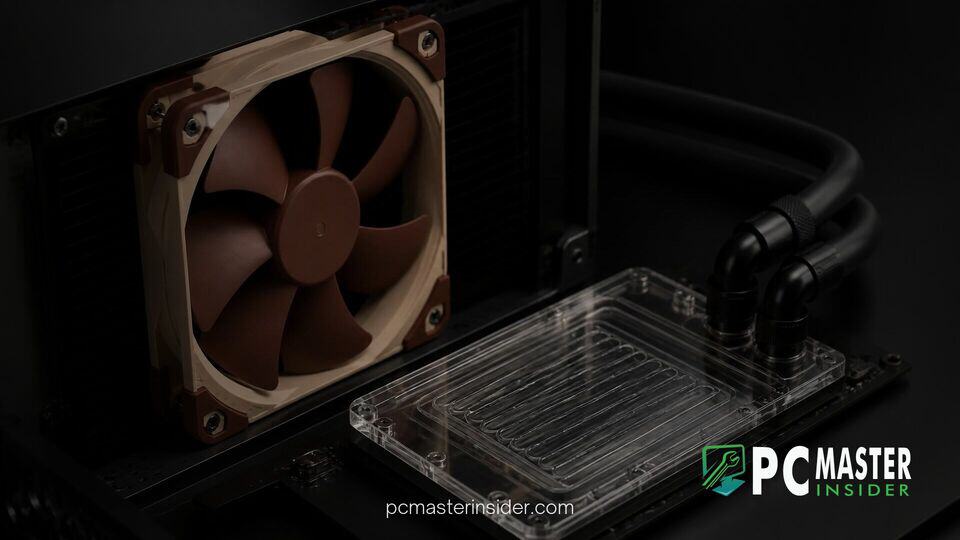
Austrian thermal solutions specialist Noctua and technology firm Forced Physics DCT have officially announced a joint research partnership to explore bringing patented JouleForce micro-channel array cooling to desktop PCs and high-performance workstations. The long-term research initiative aims to overcome traditional air cooling barriers and offer an alternative to complex liquid cooling setups without sacrificing acoustics.
By leveraging advanced geometry-driven airflow design within metallic micro-channels, JouleForce technology enables extreme fin-to-air heat transfer. However, adapting server-grade micro-channel hardware to desktop enclosures introduces significant static pressure demands that currently require industrial-grade blowers, making acoustic engineering the primary hurdle for Noctua's engineering team.
Noctua and Forced Physics Partner on JouleForce Cooling
The collaboration between Noctua and Forced Physics DCT represents an ambitious exploration into high-density thermal management. Announced on September 24, 2026, the long-term research and development project is not tied to a specific commercial product or launch window. Instead, both engineering teams are evaluating whether Forced Physics' proprietary JouleForce micro-channel arrays can be scaled down into a form factor suitable for quiet desktop computers and professional workstations.
Forced Physics DCT originally engineered its JouleForce technology for high-density enterprise environments, data centers, and rack servers where power consumption per node routinely exceeds traditional limits. By replacing standard heatsink fin stacks with densely aligned micro-channel structures, the technology can dissipate massive thermal loads using air alone. The ultimate goal of the partnership is to deliver the extreme cooling performance typically associated with liquid loops while retaining the maintenance-free, long-term reliability of traditional air coolers.
Eliminating the Thermal Boundary Layer in High-Performance PCs
Traditional air cooling designs rely on forcing air through aluminum or copper fin arrays. As air flows across conventional flat heatsink surfaces, a slow-moving layer of air known as the thermal boundary layer builds up along the fins. This boundary layer acts as an unwelcome thermal insulator, reducing heat transfer efficiency and forcing hardware manufacturers to increase fan speeds or enlarge total heatsink surface area.
JouleForce micro-channel technology fundamentally disrupts this dynamic through geometry-driven molecular collisions. By forcing intake air through precisely shaped micro-channel walls, the boundary layer is prevented from fully forming. As a result, air absorbs heat continuously along the entire length of every micro-channel, maximizing thermal transfer efficiency. This approach allows high-TDP processors to remain cool under sustained workloads using substantially lower air volumes than standard tower coolers requires.
Technical Challenges of Bringing Micro-Channel Arrays to Desktops
While JouleForce arrays offer exceptional heat dissipation efficiency, bringing micro-channel architecture to consumer PC builds introduces unprecedented engineering obstacles. The tight physical tolerances of micro-channels create a steep system impedance curve. In simple terms, forcing air through thousands of tiny channels generates severe airflow resistance and a massive static pressure drop.
In enterprise server environments, high static pressure resistance is easily overcome by ducting micro-channel modules to loud, multi-stage industrial blowers, high-speed centrifugal fans, or vacuum pumps. However, these enterprise solutions generate intolerable noise levels that are completely unacceptable for home offices or gaming setups. To make micro-channel cooling viable in home environments, Noctua must engineer quiet fan impellers capable of delivering high static pressure without exceeding acoustic thresholds.
Static Pressure Demands and Acoustic Noise Constraints
Roland Mossig, CEO of Noctua, highlighted the core technical challenge facing the partnership: "Forced Physics are advancing the limits in terms of fin-to-air heat transfer, and we are excited to explore what it would take to make that work in a quiet desktop system. The pressure levels this technology requires in today's implementations are currently supplied by equipment nobody would want on or under their desk, so this is a demanding, long-term engineering task and one that we are eager to tackle".
Beyond overcoming fan noise, Noctua engineers must tackle air sealing and system integration challenges. Because micro-channel arrays generate high backpressure, any tiny gap in the shroud or mounting hardware allows air to bypass the cooling channels entirely. Achieving a tight air seal around CPU sockets while preserving the easy installation and socket compatibility PC builders expect presents a complex design puzzle.
What JouleForce Technology Means for Next-Gen PC Cooling
As modern CPUs and GPUs push power draw higher with every generation, thermal throttling has become a central challenge for desktop builders. While modern active cooling systems and all-in-one liquid setups have helped manage high thermal outputs, many enthusiasts prefer air coolers due to their risk-free operation and lack of mechanical pumps or fluid breakdown risks.
If Noctua and Forced Physics successfully adapt JouleForce micro-channels for consumer PCs, it could introduce a viable third cooling category. Desktop users could gain liquid-grade thermal dissipation capabilities without worrying about pump failures, fluid evaporation, or coolant leaks. This development would be especially beneficial for small form factor PCs and compact workstations where space for thick liquid radiators is severely restricted.
The research initiative highlights Noctua's ongoing interest in pushing physical limits through advanced engineering. While commercial products utilizing JouleForce micro-channels remain years away from retail shelves, this partnership signals an exciting step toward solving the heat density challenges of next-generation PC hardware.