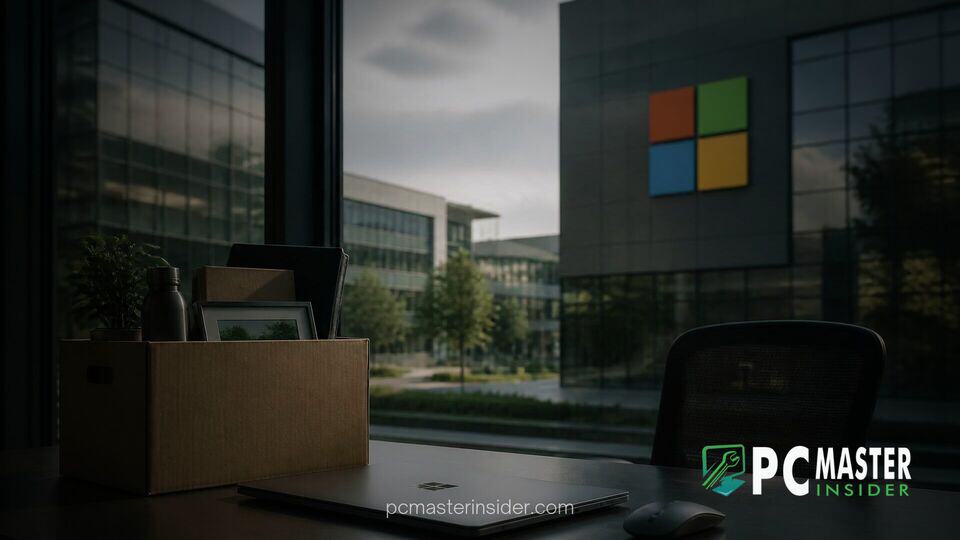
Microsoft has announced a major workforce adjustment by offering voluntary exit packages to roughly 60,000 employees worldwide. The initiative applies to approximately a quarter of the company's global staff as the tech giant balances operational expenses against massive capital expenditure in artificial intelligence infrastructure.
The voluntary buyout option allows eligible workers across several major geographic hubs to transition out of the organization with financial support. This initiative follows smaller localized adjustments made earlier in the year, reflecting broad changes across tech enterprise budgeting strategies.
microsoft offers voluntary buyouts 60000 employees in restructuring drive
Microsoft offers voluntary buyouts to 60,000 employees as part of an effort to give teams flexible exit options while realigning operational spending. The plan covers workers across participating divisions in the United States, Canada, the United Kingdom, and India. Eligible staff members up to level 70 on Microsoft's internal hierarchy scale can opt into the package, which extends up to general manager and vice president roles. The company has established an early December deadline for employees to decide whether to participate.
Microsoft Outlines Voluntary Buyout Terms for 60,000 Staff
In an internal communication distributed to staff, Chief People Officer Amy Coleman detailed the structure of the Voluntary Exit Offer (VEO). Coleman noted that the program provides employees considering career shifts a choice to transition with financial backing while giving business units a voluntary mechanism to adapt to evolving operational requirements.
The financial incentives provided in the program align with Microsoft's standard severance framework. Depending on level and tenure, participants are eligible to receive up to 39 weeks of base salary, or up to 12 months for higher job tiers. The package also encompasses continued healthcare coverage for a fixed term, standard stock vesting periods, and professional outplacement services to assist during the career transition.
Unlike traditional involuntary workforce reductions, the voluntary buyout scheme allows staff to choose their departure without performance or age qualifications being applied. However, company officials clarified that voluntary offers do not entirely preclude future structural adjustments should conditions demand further rebalances.
Eligible Divisions and Exempt Departments
Participation in the voluntary exit offer varies significantly depending on business priorities, ongoing customer commitments, and organizational requirements. Operating units such as AI experiences, corporate finance, human resources, and general administrative roles have been included in the buyout scope.
Conversely, critical operational areas have been excluded from the program to ensure ongoing business continuity. Departments such as physical data center construction, cloud infrastructure maintenance, security, and specific direct sales organizations will not participate in the offer. This selective availability reflects a targeted effort to safeguard core operational capabilities while reducing expenses in secondary areas.
Strategic Pivot Toward AI Capital Expenditure
The timing of the voluntary exit program underscores the significant financial pressure modern technology giants face while scaling artificial intelligence capabilities. Enterprise capital commitments for server chips, data center real estate, and power supply arrangements have surged exponentially across the industry.
To support vast workloads like generative modeling, Microsoft has committed billions in capital expenditures. Supporting these investments requires structural efficiency gains elsewhere in the business. Reallocating payroll expenditure directly into cloud hardware and energy infrastructure remains a primary driver behind workforce reshaping efforts.
Parallel technological changes within internal software infrastructure also influence headcount needs. Innovations in internal productivity tools, automated deployment systems, and enterprise cloud operations allow larger technical workloads to be sustained by leaner operational teams.
Impact on Windows and Xbox Workforce Architecture
The buyout program touches several legacy software and hardware units, including consumer-facing product groups. Divisions such as Windows and Xbox are participating in the offer as leadership teams reassess budget allocations for product development.
In the gaming sector, Microsoft has adjusted leadership and organizational hierarchies following recent restructuring. For instance, notable organizational shifts occurred earlier when Xbox COO Helen Chiang left Microsoft following internal policy violations, adding to broader leadership adjustments across the division.
Simultaneously, engineering focus within core product platforms has shifted toward deep system integration and infrastructure optimizations. For desktop platform development, engineering updates continue across release channels, as seen when Windows 11 26H2 reached full availability for eligible 24H2 and 25H2 PCs. Operational changes are also evident in underlying platform security architectures; recently, Microsoft ended Pluton TPM 2.0 integration for 2026 AMD and Qualcomm chips to return security hardware responsibilities back to silicon vendors.
The enterprise software ecosystem continues to see rapid cycles of maintenance and user interface developments. IT management teams have dealt with ongoing OS updates alongside specialized administrative releases, such as when Microsoft issued OOB updates KB5134133 and KB5134134 for Windows 11 to update root certificate trust chains. Enterprise productivity platforms continue to evolve as well, highlighted by updates where Microsoft added a unified inbox feature to the new Outlook for Windows to streamline multi-account workflow management.
The introduction of the voluntary exit offer signals a continuing effort by major tech firms to optimize corporate structures. By offering structured financial transitions to thousands of eligible employees, Microsoft aims to streamline headcount voluntarily while continuing its heavy capital investment into next-generation cloud and AI capabilities.