
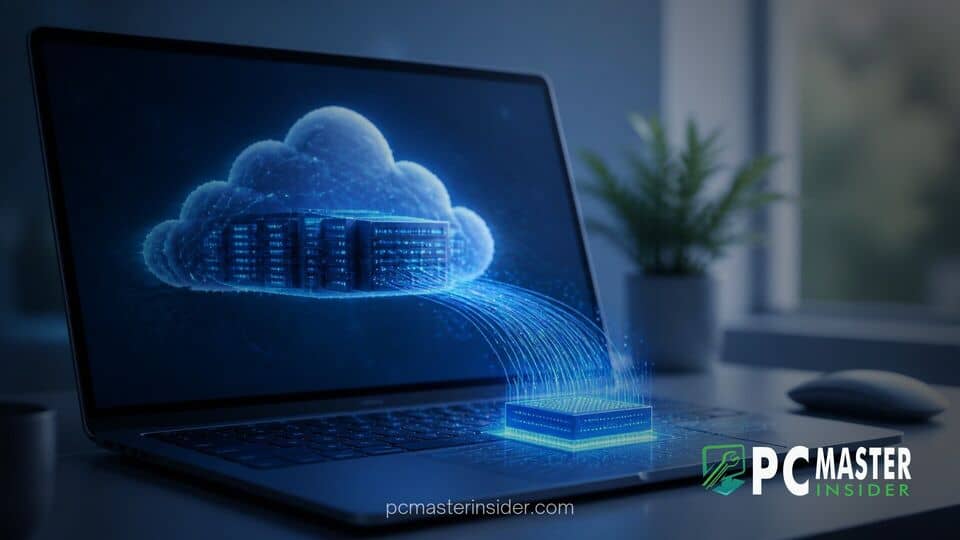
The enterprise artificial intelligence landscape is undergoing a massive paradigm shift. For years, organizations faced a binary choice when deploying machine learning models: run heavy workloads entirely in the cloud, incurring latency and bandwidth costs, or run simplified models locally on user devices with severe computational limits. Today, Microsoft is bridging this gap by expanding its cloud-to-edge continuum, seamlessly extending cloud infrastructure directly to end-user hardware.
Through advanced hybrid orchestration, Microsoft Azure AI local PC processing represents a unified framework where the massive scale of hyperscale data centers meets the dedicated power of modern Neural Processing Units (NPUs) inside Copilot+ PCs. This architecture allows AI workloads to dynamically shift between cloud microservices and local hardware based on performance demands, data privacy requirements, and network conditions. In this comprehensive explainer, we will explore how this hybrid approach works, break down its core components, examine practical enterprise use cases, and look at what this evolution means for developers and organizations worldwide.
Bridging Cloud and Local AI Capabilities
To understand why this hybrid expansion is so critical, it helps to look at how enterprise computing evolved. Historically, data centers handled large language models (LLMs) like GPT-4, while endpoint devices managed light, deterministic tasks. However, as generative AI models became embedded into everyday desktop applications, relying entirely on the cloud created noticeable friction. Network congestion, round-trip latency, and continuous API costs quickly added up.
Microsoft’s hybrid approach solves these challenges by treating the local PC not as an isolated terminal, but as an intelligent, distributed node of Azure itself. Using intelligent orchestration frameworks such as Windows Copilot Runtime and Azure AI Foundry, workloads are automatically partitioned. A complex query might send its high-level reasoning task to Azure AI endpoints while offloading real-time audio transcription, image segmentation, or context vectorization to the local NPU.
Hardware Requirements for Local AI Workloads
Unlocking local AI processing at enterprise scale requires modern hardware designed specifically for matrix math and parallel computing. Traditional CPUs and GPUs can execute AI operations, but they often do so at the expense of high power consumption and thermal throttling. The standard for local execution revolves around dedicated NPU architecture:
- Dedicated NPU Performance: Next-generation Copilot+ PCs equipped with silicon from Qualcomm (Snapdragon X Series), Intel (Core Ultra), or AMD (Ryzen AI) must deliver a minimum threshold of 40+ TOPS (Trillions of Operations Per Second) dedicated exclusively to AI acceleration.
- Unified Memory Architecture: Local AI execution relies heavily on low-latency memory bandwidth. Modern systems require at least 16GB to 32GB of LPDDR5x RAM to keep small language models (SLMs) resident in memory without swapping.
- DirectML and ONNX Runtime Support: Software stacks utilize DirectML and Microsoft ONNX Runtime to translate high-level Azure AI models into optimized execution paths that run directly on local silicon drivers.
To visualize this dynamic, consider the analogy of a high-end restaurant kitchen. Azure AI functions as the off-site master prep kitchen, handling massive prep work, deep recipes, and large bulk orders that require specialized industrial equipment. The local PC’s NPU acts as the line cook at the front station, instantly assembling personalized dishes, garnishing plates, and handling immediate customer requests without waiting for a delivery driver. When both work in tandem, the dining experience is fast, seamless, and cost-effective.
Integration With Microsoft 365 Services
The practical benefits of this hybrid architecture become immediately apparent inside everyday enterprise tools like Microsoft 365. Applications such as Word, Excel, Teams, and PowerPoint are no longer simple cloud clients; they are active runtime environments that leverage Microsoft Azure AI local PC processing to deliver real-time assistance.
For example, during a video conference in Microsoft Teams, local NPUs manage real-time background blur, gaze correction, and audio noise suppression locally, consuming minimal battery. Simultaneously, Azure AI in the cloud processes the broader organizational context, retrieving enterprise knowledge graphs and generating real-time meeting summaries across multi-department databases. This hybrid divide ensures that high-bandwidth media remains on-device while complex analytical insights tap into cloud-scale telemetry.
Reducing Latency for AI-Powered Applications
Latency is the primary enemy of natural human-computer interaction. When typing with an AI auto-complete assistant or drawing with generative canvas tools, even a 300-millisecond network delay breaks user focus and feels sluggish. By deploying Small Language Models (SLMs) like Phi-3 directly to the local Windows platform, response times drop to single-digit milliseconds.
Consider the performance gains achieved across typical operational workflows:
- Real-time Syntax and Grammar Generation: Text generation and code completion run locally on the NPU, offering instant feedback as fast as the user can type.
- Contextual Vector Retrieval: Local vector databases analyze open documents and local user file indices without uploading confidential raw files over public networks.
- Failover Resilience: When traveling or working in low-connectivity environments, applications seamlessly fall back to local ONNX models, maintaining core productivity features until an Azure cloud connection is restored.
Future Outlook for Hybrid AI Computing
As silicon efficiency improves and model optimization techniques like quantization and pruning mature, the line between cloud intelligence and local processing will continue to blur. Microsoft is actively laying the foundation for a continuous computing fabric where enterprise IT administrators can manage local desktop models using the exact same Azure governance, policy, and security protocols used for cloud infrastructure.
Security and compliance benefit immensely from this evolution. Sensitive financial data, healthcare records, or proprietary source code can remain locked within the local memory space of an enterprise PC, analyzed entirely by on-device models, while only anonymized telemetry or high-level summaries are ever synchronized back to Azure cloud repositories. This zero-trust data boundary provides unprecedented privacy guarantees for regulated industries.
Developer Implications for Windows Ecosystem
For software engineers and IT architects, this convergence changes how desktop and web applications are designed. Developers no longer need to write custom engine code for disparate hardware platforms or build complex manual fallback loops for offline availability.
Key developer advantages include:
- Unified API Surfaces: Developers can build against Windows Copilot Runtime APIs that automatically select the most efficient compute target—switching between local NPU, local GPU, or Azure cloud endpoints behind the scenes.
- Cross-Platform Model Portability: Models trained in Azure AI Studio can be exported directly into ONNX format, optimized for edge devices, and pushed to fleet endpoints using standard enterprise device management tools like Microsoft Intune.
- Cost Optimization at Scale: By offloading high-frequency, low-complexity inference calls to client hardware, enterprises dramatically reduce their recurring Azure API consumption bills while delivering faster user experiences.
Summary: The Edge-Cloud Synergy
Microsoft’s expansion of Azure AI infrastructure into local PC processing represents a pragmatic, powerful vision for the future of enterprise technology. Rather than forcing a choice between the infinite scale of the cloud and the instant responsiveness of local silicon, this hybrid ecosystem delivers the best of both worlds.
By pairing local NPU acceleration with Azure cloud microservices, modern organizations achieve lower operational costs, minimal latency, improved offline capabilities, and enhanced data privacy. As Copilot+ hardware becomes standard enterprise equipment, Microsoft Azure AI local PC processing will serve as the invisible engine driving the next generation of intelligent desktop software.