
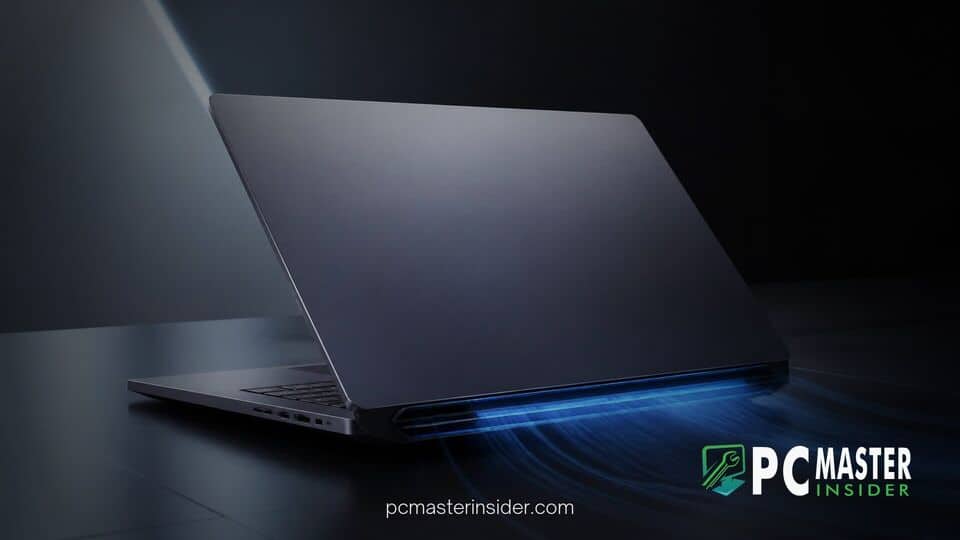
At the Lenovo Innovation World event during IFA 2026 in Berlin, Lenovo showcased the ThinkBook Project AeroBlade concept laptop. The prototype eliminates traditional motorized cooling fans in favor of an advanced solid-state thermal architecture built in partnership with Frore Systems.
By utilizing solid-state AirJet modules instead of heavy heat pipes and mechanical fans, Lenovo has engineered a 14-inch ultraportable notebook that measures less than 10mm thick and weighs under 830 grams. The design promises whisper-quiet active cooling without sacrificing sustained compute performance.
Lenovo ThinkBook AeroBlade Design and Form Factor
The ThinkBook AeroBlade concept represents a structural redesign aimed at extreme portability. Constructed from a lightweight magnesium-aluminum chassis, the device achieves a profile measuring roughly 9.95mm at its slimmest point, putting its thickness on par with modern foldable smartphones. Tipping the scales at under 830 grams, it stands among the lightest 14-inch notebooks ever demonstrated.
To maintain such a compact footprint, Lenovo streamlined every internal component. The laptop incorporates a custom miniaturized motherboard paired with a high-efficiency OLED display panel. Connectivity remains versatile despite the thin profile, offering three Thunderbolt 4 USB-C ports alongside support for Wi-Fi 7 wireless networking. This approach contrasts with typical ultraportables that compromise heavily on expansion ports. Consumers seeking portable productivity solutions can also examine how other vendors approach light designs, such as when Acer Debuts 799g Swift Blade 14 Laptop with Intel Chips at IFA 2026.
Integration of Frore Systems AirJet Solid-State Cooling
At the core of the AeroBlade architecture is Lenovo's custom Active Flow thermal solution, which integrates solid-state active cooling hardware supplied by California-based Frore Systems. Rather than relying on rotating plastic fan blades driven by electric motors, the system uses tiny solid-state AirJet Mini modules. Each module measures only a few millimeters in thickness and operates through internal piezoelectric membranes.
When electrical currents pass through these membranes, they vibrate at ultrasonic frequencies far beyond the threshold of human hearing. These high-frequency vibrations pull air into intake vents located directly on top of the module. The air passes across integrated internal heat spreaders before being forcefully expelled through narrow exhaust ports along the rear edge. In the AeroBlade, Lenovo arrayed four AirJet Mini modules across a unified copper heat spreader that sits above an Intel Core Ultra 200 series processor, enabling direct active heat transfer without mechanical noise.
Thermal Efficiency and Noise Performance Without Fans
Historically, laptop manufacturers faced a strict trade-off when attempting to build fanless computers. Passive cooling systems rely entirely on ambient heat dissipation through the metal body of the laptop, which frequently leads to severe thermal throttling when the CPU encounters sustained workloads. Conversely, conventional active cooling fans generate noticeable noise, gather dust over time, and require substantial vertical clearance inside the laptop frame.
The Lenovo ThinkBook AeroBlade solid state cooling system bridges this gap by generating high air pressure within a compact space. According to technical details shared by Frore Systems, individual AirJet Mini units generate up to 17 times more back pressure than standard laptop fans. This high-pressure delivery allows air to flow through extremely tight internal channels and narrow exhaust vents without requiring massive intake grills. Each AirJet Mini unit can dissipate up to 7.5 watts of thermal energy, giving the four-module array in the AeroBlade a combined thermal capacity of up to 30 watts. This allowance matches the thermal design power requirements of modern processor platforms, allowing the system to handle demanding background tasks and AI processing while remaining practically silent.
Market Outlook for Fanless Ultraportable Laptops
The introduction of the ThinkBook AeroBlade highlights a broader industry shift toward silent, highly efficient computing hardware. During the reveal in Berlin, Frore Systems Chief Executive Officer Seshu Madhavapeddy emphasized that removing thermal bottlenecks is essential for next-generation mobile devices. He noted that as artificial intelligence applications transition toward continuous, reasoning-based workloads, laptops require steady thermal dissipation rather than short bursts of cooling capacity.
While Lenovo has categorized the Project AeroBlade as a proof-of-concept device rather than an immediately available retail model, its refined construction indicates that solid-state cooling is nearing commercial viability for mass production. Eliminating moving mechanical parts not only lowers the overall height of mobile hardware but also enhances long-term hardware reliability by preventing dust accumulation inside internal heat sinks. Hardware maintenance and operating system stability remain key priorities for PC users, especially as systems evolve; for instance, users managing software environments can review How to Use System Restore on Windows 11 to keep their systems operating reliably.
Hardware manufacturers are also paying closer attention to physical space efficiency across various form factors. Beyond thin laptops, solid-state cooling modules could eventually influence compact desktops, handheld gaming consoles, and mobile workstations where internal space is at a premium. Devices with unique physical transformations are gaining traction across the industry, similar to how Acer Previews Project DualPlay Mini Handheld PC with Swivel Keyboard at IFA.
Lenovo's implementation of solid-state cooling in the ThinkBook AeroBlade concept demonstrates that ultra-slim laptops no longer need to sacrifice performance or endure noisy cooling fans. By successfully integrating Frore Systems' AirJet technology into a sub-10mm form factor, Lenovo has laid out a clear blueprint for the next generation of silent, ultraportable personal computers.