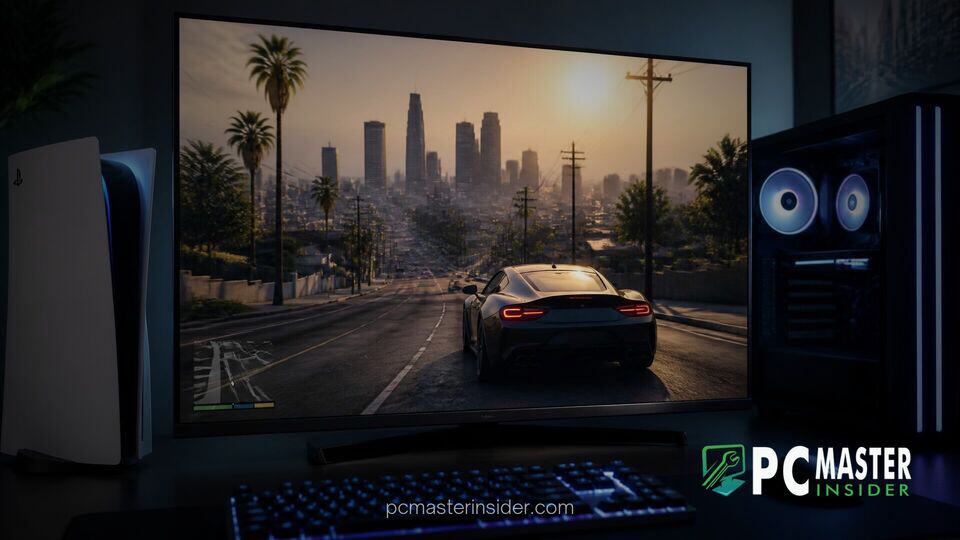
In a surprising leap forward for console software reverse engineering, developers working on the open-source PlayStation 5 project have demonstrated commercial 3D software executing on desktop operating systems. The experimental software has successfully rendered the native PS5 build of Grand Theft Auto 5, maintaining performance levels between 40 and 60 frames per second during early scenario testing.
While the demonstration confirms significant breakthroughs in deciphering complex graphics pipelines and system calls, severe stability limitations remain. The current build crashes within minutes of active gameplay, illustrating that while raw rendering efficiency is advancing rapidly, complete architectural translation requires further development.
kytyps5 ps5 emulator gta 5 pc 60 fps milestone and technical breakdown
The latest demonstration of the kytyps5 ps5 emulator gta 5 pc 60 fps benchmark represents a vast acceleration in development velocity. Just two months prior, the software struggled to advance past basic configuration screens and static menus. The recent update allows the title to load directly into real-time 3D environments with functioning physics, audio, and character input controllers.
footage shared publicly by independent testers demonstrates the opening North Yankton prologue mission running at fluid frame rates. Core character movement, shooting mechanics, and initial environmental rendering function as intended under experimental translation layers, providing a glimpse into the progress made across the open-source developer ecosystem.
KytyPS5 Achieves 60 FPS in GTA 5 Opening Scenes
The captured test sessions highlight impressive visual output during early mission sequences. The emulator successfully interprets complex shaders, lighting routines, and spatial audio cues native to the PlayStation 5 build, allowing the engine to hit peak performance thresholds of 60 frames per second inside enclosed environments.
However, visual fidelity is not without flaws. Observers noted persistent graphical artifacts, including geometry flickering, missing textures, and inconsistent shadow casting. Despite these cosmetic defects, the underlying engine logic remains synchronized with the rendering thread long enough to deliver responsive control during initial combat sequences.
Hardware Requirements and Test Bench Specs
Achieving these performance metrics requires substantial computational overhead due to the intensive nature of real-time translation. The demonstration footage was captured on high-end enthusiast desktop hardware engineered to handle demanding workloads. Enthusiasts interested in modern PC optimization often follow developments such as how Microsoft focuses on core system quality to maximize desktop performance.
- Central Processor: AMD Ryzen 9 9950X3D
- Graphics Card: AMD Radeon RX 7900 XT
- System Memory: High-bandwidth DDR5 RAM
- Operating System: 64-bit Windows 11
The heavy reliance on top-tier hardware underscores the inherent inefficiency of early-stage software emulation. Because instruction sets must be dynamically recompiled and system calls translated on the fly, system memory and CPU cache architectures face extraordinary pressure during execution.
Current Stability Issues and Crash Limitations
Despite reaching high frame rates, session longevity remains severely restricted. In nearly every public test run, the emulator encounters a critical memory fault or unhandled system instruction within a few minutes of active play. During the prologue mission, execution typically halts completely when players attempt to exit the bank facility toward the exterior shootout sequence.
Testing in open-world free-roam scenarios yields similar instability. When loaded into vast environments, frame rates degrade rapidly toward 15 FPS before the application terminates abruptly. Developers attribute these crashes to missing system calls, incomplete memory management features, and unoptimized GPU pipeline synchronization.
The Rapid Progress of PlayStation 5 Emulation on PC
The pace of development across the PlayStation 5 emulation landscape has taken many industry observers by surprise. Because modern consoles utilize x86-64 CPU architectures similar to conventional personal computers, certain low-level hardware translation hurdles are less daunting than those faced by legacy consoles. However, proprietary graphics APIs, custom security modules, and unified memory architectures present complex challenges for software engineers.
KytyPS5 is not the only project gaining traction within the open-source community. Parallel initiatives like SharpEmu and ShadPS4 are actively targeting low-level accuracy and system stability. While some projects prioritize infrastructure and precise system call emulation over raw speed, others focus on game-specific hacks to boost frame rates in popular commercial titles. Smaller projects, such as porting legacy software to modern 64-bit Windows, showcase the wide range of technical preservation efforts underway today.
Beyond Grand Theft Auto 5, developers have demonstrated lighter 2D and low-demand 3D titles running at consistent frame rates with far fewer stability issues. Games such as Tomb Raider IV-VI Remastered and Pac-Man World Re-PAC have achieved steady 60 FPS playback with minimal graphical degradation, proving that the underlying foundation of the emulator is expanding rapidly.
Hardware shifts and software optimizations across consumer platforms continue to shape how modern operating systems interact with demanding applications. Ongoing platform developments, including memory optimizations for Windows systems, play a pivotal role in ensuring system stability during heavy background operations. Furthermore, overall system responsiveness relies heavily on continuous driver improvements, much like initiatives aimed at driver verification on Windows 11.
Industry analysts emphasize that full commercial compatibility for flagship open-world titles remains months or years away. As hardware developers roll out next-generation silicon, similar to high-density workstation hardware platforms, the computational head-room available for complex emulation tasks will continue to grow.
In summary, while KytyPS5 running Grand Theft Auto 5 at 60 FPS marks a landmark technical milestone for open-source PlayStation 5 research, significant work remains before full-length commercial titles become fully playable on consumer PCs.