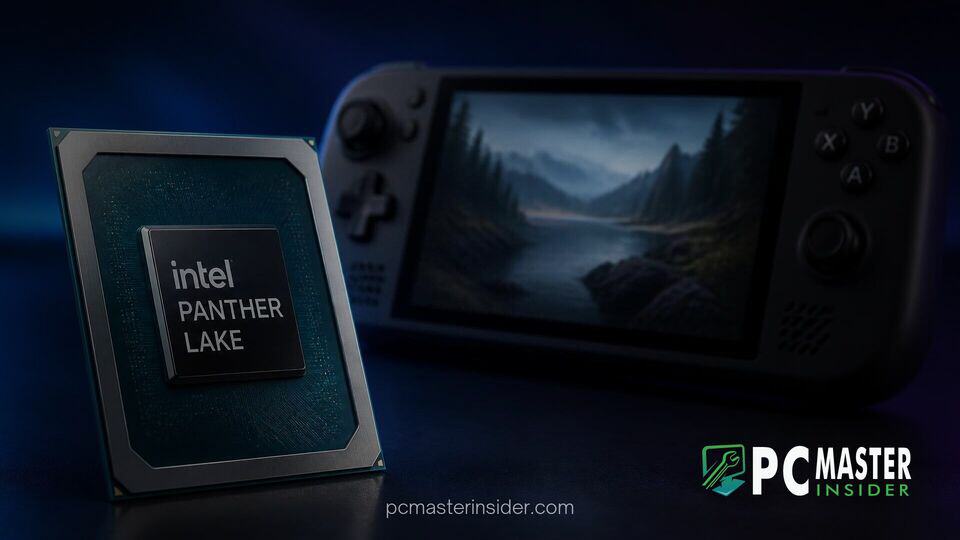
Intel is reportedly preparing a streamlined Panther Lake processor aimed at lower-cost portable gaming devices. Leaked specifications indicate that the chip could allow hardware makers to offer cheaper Intel-powered handhelds beneath existing premium tiers.
The upcoming configuration represents a distinct strategy from Intel's high-end handheld offerings. By reducing core counts and graphics units, the chip promises to lower component costs while maintaining modern architectural features.
Leaked Specifications Detail 8-Core Intel Panther Lake Processor for Handhelds
Industry reports indicate that Intel is developing an entry-level Intel Panther Lake budget handheld processor to expand its footprint in the portable PC market. Details published by hardware leaker Jaykihn reveal a 4+0+4 CPU arrangement paired with 4 Xe3 graphics cores. This setup marks a significant shift from Intel's top-tier handheld silicon, which features considerably larger compute clusters.
Existing handheld processors in the line, such as the Arc G3 Extreme and standard Arc G3, rely on a 14-core CPU architecture combined with 12 or 10 Xe3 GPU cores. By contrast, the newly leaked variant scales back core counts to lower production costs and thermal demands. Hardware analysts note that while Intel has not publicly confirmed product names or power targets, the design matches silicon layouts already produced for ultralight laptops.
Architectural Breakdown of the 4P+0E+4LP CPU and 4 Xe3 GPU Configuration
The reported CPU design uses four Performance cores (P-cores) and four Low-Power Efficient cores (LP-E cores), completely omitting standard Efficient cores (E-cores). This 4P+0E+4LP structure provides eight total processing threads for basic system operations and active gaming. The P-cores handle demanding primary tasks, while the low-power island cores manage background background processes to preserve battery power during low-load scenarios.
On the graphics side, the integrated GPU incorporates four Xe3 cores based on Intel's Celestial architecture. Although this is a reduction from the 12 Xe3 cores found on the Arc B390 integrated graphics tier, the underlying architecture supports modern features such as XeSS AI-based upscaling and updated media engines. Hardware trackers highlight that this specific 4P+0E+4LP plus 4 Xe3 layout is already active in thin laptop lines like the Core Ultra 7 355, suggesting Intel can repurpose established silicon for dedicated handheld platforms.
How an Entry-Level Chip Fits Into Intel's Broader Portable PC Strategy
The handheld gaming market has expanded rapidly, but price points for premium devices remain high. Current flagship handhelds equipped with top-tier Intel Arc G3 or AMD Ryzen Z1 Extreme processors often launch at prices ranging from several hundred to over a thousand dollars. High component expenses, combined with elevated memory and storage costs, have created a gap in the market for budget-conscious buyers.
Introducing a smaller Panther Lake variant allows Intel to target system builders seeking lower hardware price points. Rather than competing exclusively in the ultra-enthusiast tier against maximum-spec handhelds, device manufacturers could use this processor to create lighter, cooler, and less expensive alternatives. Industry observers view this move as a direct attempt to challenge entry-level portable options while expanding x86 game compatibility across lower price brackets.
Expected Performance Targets and Market Outlook for Budget Handheld Gaming
Performance projections based on equivalent laptop hardware indicate a capable baseline for entry-level gaming. In benchmark evaluations of similar silicon, single-core CPU throughput shows strong results compared to older handheld processors, while multi-core performance remains sufficient for general gaming tasks. The primary limitation will be raw graphical output, as four Xe3 cores will require resolution scaling or lower visual presets in demanding modern titles.
However, the performance profile aligns well with indie titles, older AAA games, and emulation software. Additionally, native x86 instruction support allows handhelds running this silicon to execute PC game libraries without complex translation layers. Analysts suggest that if manufacturers pair this chip with competitive system pricing, it could establish a strong foothold among casual players and travellers looking for lightweight portable PCs.
While Intel has yet to officially announce release dates or final retail pricing for devices using this configuration, the leak signals growing diversification in the handheld ecosystem. As hardware vendors explore lower price points, entry-level silicon could make PC gaming on the go accessible to a far wider audience.