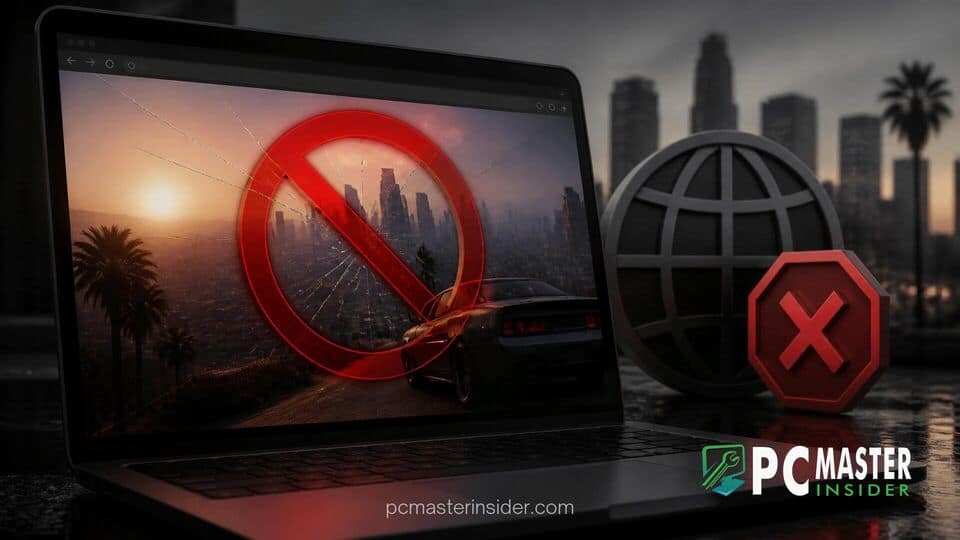
An unofficial browser-based port of Grand Theft Auto 5 was taken offline merely hours after going viral across social media platforms. The project leveraged WebAssembly and modern web rendering APIs to execute Rockstar Games' open-world title directly inside web browsers on both PC and mobile devices.
Players who attempted to visit the hosting site shortly after its sudden surge in traffic were met with connection errors and service blocking notices. While no formal public statement has been issued by publisher Take-Two Interactive, industry analysts and developers note that the fast removal aligns with the publisher's strict enforcement of copyright protections.
AI-Powered WebAssembly Port Brings GTA 5 to Web Browsers
The technical implementation behind the gta 5 browser port webassembly release relied on compiling native executable components into client-side web binaries. Rather than relying on cloud gaming services like GeForce NOW or Xbox Cloud Gaming, which stream video feeds from remote server farms, this implementation ran locally inside the web browser. By translating heavy C++ systems into WebAssembly64 and binding graphics rendering to WebGPU, the browser tab processed game logic, physics, and world rendering directly on the local system hardware.
Reports and technical teardowns indicate that the development process was accelerated through the use of AI assistance alongside existing code assets. Developers utilized modern AI translation pipelines to streamline function mapping, helping convert complex Direct3D 11 graphics commands into WebGPU-compatible WebGPU Shader Language (WGSL) shaders.
How WebAssembly and AI Enabled Local Browser Execution
Running an expansive game title inside a web browser presents massive technical hurdles, particularly regarding memory management and storage limits. A standard PC installation of Grand Theft Auto 5 requires up to 100GB or more of local storage, which cannot be cached easily in standard browser memory buffers.
To overcome this limitation, the web implementation utilized a hybrid streaming model. The initial setup loaded an initial boot download of approximately 600MB to 700MB containing essential engine data, scripts, and initial rendering instructions. Additional game assets, such as high-resolution textures, audio archives, and map data, were streamed dynamically on demand via HTTP range requests directly into the browser's Origin Private File System. This allowed players to launch into Los Santos in under three minutes without needing to download the entire game package beforehand.
The advancement mirrors similar technological shifts in browser performance, where native containerized applications and WebAssembly are blurring the lines between standalone software and web apps. Similar web-based optimizations have been seen across enterprise software, including recent developments where Microsoft brought native WSL container support to Windows 11 to speed up virtualized workloads.
Take-Two Interactive Response and Immediate Takedown Notice
The viral spread of the web project immediately caught the attention of copyright holders. Within hours of links circulating on X (formerly Twitter) and Reddit showing smooth gameplay inside Google Chrome, access to the domain playgta5.com was cut off. Visitors attempting to access the site were met with Cloudflare blocks before the page domain completely ceased loading the WebAssembly engine.
Take-Two Interactive has established a consistent legal precedent regarding unauthorized distributions, modified source code leaks, and standalone reverse-engineering projects. The publisher previously enforced digital rights takedowns on browser-based ports of Grand Theft Auto: Vice City and shut down native fan-made console ports. Because the WebAssembly port executed compiled proprietary binaries and pulled official game assets from public hosting servers without authorization, it violated copyright and intellectual property guidelines.
Impact on Web-Based PC Game Emulation and Preservation
The rapid emergence and subsequent takedown of the browser port highlight a growing tension between technological capabilities and intellectual property enforcement. With WebAssembly64, WebGPU, and AI coding agents maturing, modern web browsers are increasingly capable of executing demanding 3D games that previously required specialized desktop hardware or dedicated console emulation engines.
However, running proprietary games in web browsers without proper licensing remains a legal dead end for creators. Even when fan projects do not charge money or claim ownership, distributing copyrighted assets or recompiled source code quickly triggers enforcement action. The incident serves as a clear showcase of modern web platform power, while reinforcing that major publishers will actively protect their commercial intellectual properties against unauthorized web distribution.