Global semiconductor markets are witnessing a notable deceleration in memory pricing as contract rates for dynamic random-access memory show signs of cooling. Industry data indicates that price increases for enterprise, mobile, and desktop RAM are losing momentum after months of robust, multi-quarter expansion.
Market research firms and financial analysts report that while average selling prices remain higher than last year, the dramatic surge seen over recent quarters has ended. The broader memory ecosystem is now transitioning into what experts describe as a late-stage market cycle characterized by stabilized supply and cautious enterprise procurement.
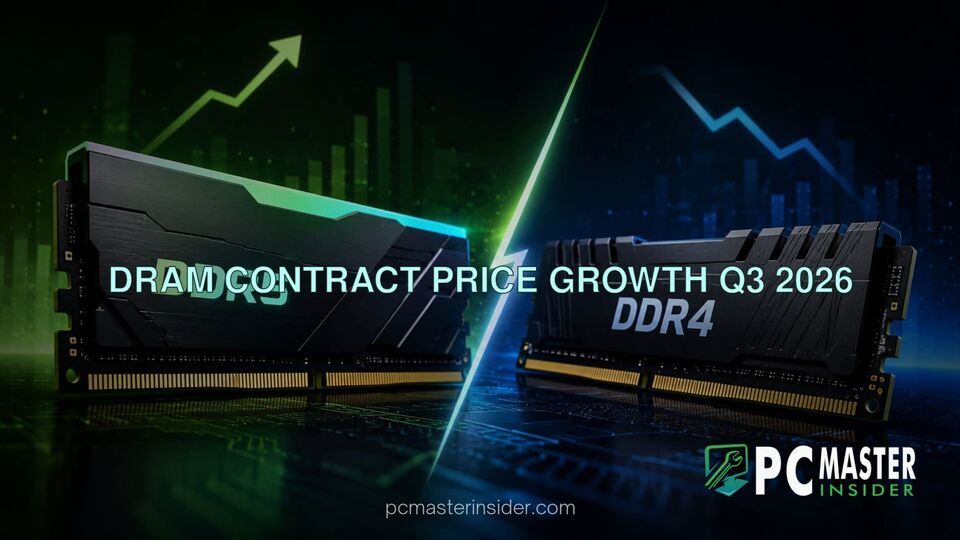
DRAM Contract Price Growth Q3 2026: Market Expansion Hits a Plateau
The latest figures tracking DRAM contract price growth Q3 2026 confirm that quarter-over-quarter rate gains have narrowed significantly across all major categories. Average contract prices for standard DDR4 and DDR5 modules increased by a modest single-digit percentage during the period, contrasting sharply with the double-digit surges recorded during previous quarters. Enterprise server modules and high-bandwidth memory products continue to command premium rates, but even these segments have experienced a tempered pace of upward adjustments.
According to supply chain indicators, major DRAM manufacturers have brought additional production capacity online while inventory levels among OEMs and module makers have gradually normalized. PC manufacturers and cloud service providers, having accumulated significant stockpiles earlier in the year to hedge against supply constraints, have moderated their purchasing volumes. This shifting dynamic between supply availability and buyer urgency has effectively capped aggressive price hikes across the spot and contract sectors.
Bernstein and Morgan Stanley Highlight Market Shift
Leading equity research firms have issued updated assessments regarding the health and direction of the semiconductor sector. Analysts at Bernstein noted in a recent client report that the structural shortage that fueled the market expansion over the past eighteen months has largely cleared. The firm emphasized that while demand for AI-centric memory architectures remains steady, conventional PC and smartphone memory segments are entering a consolidation phase.
Similarly, Morgan Stanley equity researchers highlighted that historical cycle patterns are reasserting themselves across the memory landscape. In their quarterly market commentary, the firm observed that supplier utilization rates are near capacity, leaving limited room for sudden price spikes without a corresponding surge in end-user demand. Analysts from both institutions agree that the current environment points to a late-cycle phase, where price appreciation narrows before stabilizing or slightly softening in subsequent quarters.
Impact on Consumer PC Memory and Retail RAM Prices
For system builders, enterprise IT procurement teams, and retail consumers, the deceleration in DRAM contract pricing brings a welcome reprieve. Retail prices for desktop and laptop memory kits, which surged steadily through the preceding quarters, have begun to flatten across major retail channels. DDR5 kits, in particular, are seeing consistent pricing stability as yield rates improve among tier-one memory fabricators.
While a sudden drop in retail memory costs remains unlikely in the immediate term, buyers are no longer facing the frequent upward price revisions that characterized the market earlier in the year. PC original equipment manufacturers are expected to maintain steady bill-of-materials costs for upcoming product lines, reducing the pressure to pass higher hardware expenses onto end consumers during the upcoming holiday shopping period.
Industry Outlook and Supply Expectations for Late 2026
Looking ahead toward the end of the year and into early 2027, chipmakers face the task of balancing capital expenditure with projected global demand. Advanced node transitions, particularly for next-generation DDR5 and HBM3e/HBM4 technologies, continue to absorb a substantial portion of total capital investments. However, manufacturers remain vigilant to avoid oversupply conditions that could trigger rapid price drops.
Major semiconductor vendors are expected to manage wafer input carefully to align with macro-economic conditions and enterprise IT spending forecasts. As the current memory cycle enters its mature phase, market participants will closely monitor enterprise server utilization, consumer PC refresh rates, and smartphone shipment volumes to gauge whether the market will achieve a soft landing or experience a broader cyclical adjustment in the coming year.
In summary, the cooling of contract price momentum marks a pivotal turning point for the global memory industry. As DRAM contract price growth moderates, the industry transitions from supply-constrained expansion into a balanced, late-stage environment defined by steady procurement and predictable pricing dynamics.