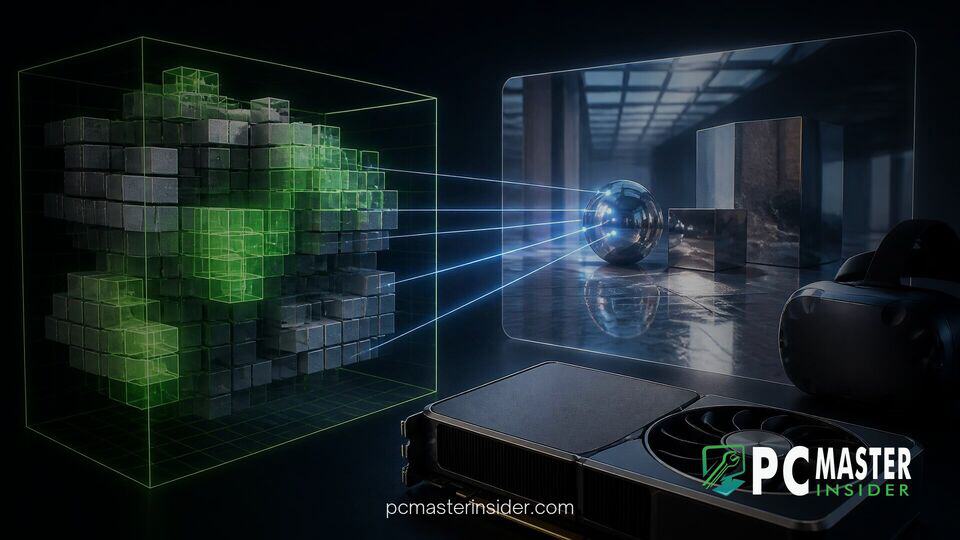
Microsoft has unveiled a major technical update to its DirectX Raytracing (DXR) framework via the DirectX 12 Agility SDK 1.722 preview, addressing one of the most persistent bottlenecks in modern graphics rendering: memory overhead. By introducing Clustered Geometry alongside Partitioned Top-Level Acceleration Structures (PTLAS), the platform drastically cuts video RAM consumption while speeding up frame rendering times across compatible GPUs.
This release represents one of the most substantial architectural shifts for DXR since its initial release in 2018. With early benchmarks demonstrating up to 90% savings in VRAM usage for dynamic acceleration structures, game developers now have the tools needed to render complex, highly detailed virtual environments without hitting hardware memory limits.
Overview of the DirectX Raytracing Architecture Update
The core innovation behind the new DXR preview lies in how 3D assets are structured and processed by graphics cards before ray tracing queries occur. Historically, ray tracing engines required building and constantly updating massive Bottom-Level Acceleration Structures (BLAS) to trace light paths against high-detail geometry. This approach demanded extensive GPU compute time and clogged dedicated video memory, forcing studios to rely on simplified proxy meshes for ray-traced reflections and shadows.
Microsoft's latest SDK introduction changes this paradigm by breaking geometry into compact, reusable clusters of primitives. Rather than rebuilding large scene hierarchies from scratch every frame, the API allows graphics cards to assemble acceleration structures using these compressed, modular building blocks. The technical shift aligns smoothly with modern game engines that prioritize fine-grained detail management, similar to how Unreal Engine handles advanced shader delivery and asset pipeline optimizations.
How Clustered Geometry and PTLAS Reduce Compute Overhead
To further minimize computational friction in large virtual worlds, Microsoft introduced Partitioned Top-Level Acceleration Structures (PTLAS) alongside Clustered Geometry. In massive open-world gaming titles, updating scene-wide acceleration structures every frame causes massive compute bottlenecks. PTLAS solves this issue by isolating updates to specific regions or partitions of a world where objects are actively moving or changing, while leaving stationary spatial data untouched.
In addition to spatial partitioning, the updated DirectX pipeline shifts acceleration structure management directly onto the GPU. GPU-driven builds eliminate unnecessary round trips between the central processor and graphics card, cutting CPU synchronization overhead. This reduction in driver latency complements broader OS-level efforts, such as updates designed to eliminate process bottlenecks in Windows 11, ensuring that PC hardware operates with minimal system friction.
VRAM Optimization and Triangle Batching Mechanics
The memory efficiency achieved through Clustered Geometry relies on compact position encoding and triangle batching. By standardizing how primitive clusters are formatted, source asset data occupies significantly less space in VRAM. Because these triangle clusters can be instanced and reused across different parts of a scene, the GPU maintains a far smaller hardware Bounding Volume Hierarchy (BVH) footprint.
This compression mechanism means graphics cards no longer need to hold redundant geometry data in video memory. In scenarios where complex geometric detail previously consumed gigabytes of VRAM just to process ray intersections, the new batching mechanics drastically reduce memory consumption.
FPS Performance Benefits for High-Resolution Gaming
While memory savings are the headline feature, the operational efficiency gains directly translate into higher framerates. By shortening acceleration structure build times, the GPU spends fewer clock cycles constructing BVH trees and more time shading pixels. In controlled hardware benchmarks, eliminating BVH rebuild bottlenecks yielded dramatic raw throughput spikes, allowing frame rates in specific synthetic tests to soar up to 66 times higher compared to unoptimized builds.
In real-world gaming applications, developers expect these features to deliver smoother frame pacing, higher baseline FPS, and a reduction in VRAM-induced stuttering. Players running games at high resolutions like 4K or ultra-wide formats will experience fewer performance drops when ray-traced shadows, reflections, and ambient occlusion are active.
directx raytracing clustered geometry vram savings
The introduction of directx raytracing clustered geometry vram savings provides a vital technical foundation for modern PC gaming hardware. By cutting acceleration structure memory consumption by up to 90%, Microsoft enables ray tracing on high-detail geometry without exceeding GPU VRAM capacities. This optimization allows lower-tier and mid-range graphics cards to run complex ray-traced games more effectively while freeing up critical VRAM for high-resolution textures.
Industry Adoption and Future Game Developer Workflows
Industry hardware vendors have moved quickly to support Microsoft's new DXR capabilities. Full day-one preview support is available across current-generation hardware lineups from NVIDIA, AMD, Intel, and Qualcomm. Driver updates enabling HLSL 6.10 and Shader Model 6.10 features are rolling out, allowing developers to test these features immediately in preview builds.
Game studios are already integrating these features into modern production workflows. Notably, NVIDIA collaborated with developer The Coalition to showcase RTX Mega Geometry capabilities in Gears of War: E-Day. Using Unreal Engine 5, the studio leveraged clustered geometry to perform real-time ray tracing against high-detail Nanite geometry directly, bypassing the need for lower-detail proxies. As more studios adopt the DirectX 12 Agility SDK, players can expect future game titles to deliver significantly higher visual fidelity alongside stable memory utilization.
With hardware vendors aligned and major game engines adopting the updated SDK, Microsoft's DXR enhancement represents a major step forward for PC graphics rendering. By delivering massive VRAM reductions and alleviating compute bottlenecks, Clustered Geometry ensures that real-time ray tracing remains scalable as game worlds continue to grow in scale and detail.