
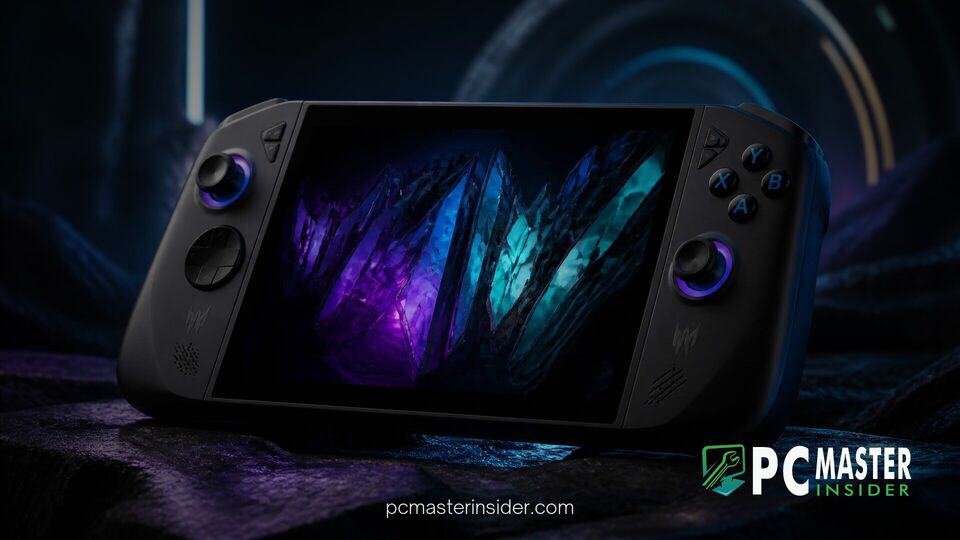
Acer officially announced the expansion of its portable hardware ecosystem at IFA 2026, revealing the compact Predator Atlas 7 gaming handheld powered by Intel Arc graphics. Designed for high performance on the go, the unit delivers a streamlined 7-inch form factor paired with modern connectivity and robust internal specifications.
The new device enters an increasingly competitive landscape, challenging existing handheld systems by offering variable refresh rate capabilities, specialized controls, and deep integration with Windows 11 gaming environments.
Acer Reveals Predator Atlas 7 Gaming Handheld at IFA 2026
The formal introduction of the Acer Predator Atlas 7 handheld highlights the manufacturer's shifting focus toward low-power, high-efficiency portable computing architecture. Arriving alongside larger devices like the 8-inch Predator Atlas 8, the Atlas 7 caters to gamers who favor a smaller chassis without sacrificing high-end visual fidelity. Positioned as a direct response to modern portable trends, the system leverages full Windows 11 support, allowing players to access major digital platforms, including Xbox Game Pass, Steam, and Epic Games Store, straight out of the box.
Hardware design plays a central role in the physical design of the Atlas 7. Weighing in as a highly pocketable unit, the handheld incorporates textured grips and ergonomic contours intended to minimize strain during extended play sessions. Acer confirmed that the model will be available in select regions starting in late 2026, providing a fresh alternative for players seeking Intel-backed silicon in a smaller profile.
7-Inch Form Factor and Display Features
At the front of the device sits a 7-inch Full HD touchscreen display running at a native 1920x1080 resolution in a standard 16:9 aspect ratio. The panel offers a smooth 120 Hz refresh rate coupled with Variable Refresh Rate (VRR) support, which dynamically syncs frame outputs to minimize screen tearing and stutter during demanding titles. The display reaches a peak brightness of 500 nits, ensuring viable outdoor readability under varied lighting conditions.
Control inputs on the Atlas 7 include standard asymmetric thumbsticks, a directional pad, primary action buttons, and analog shoulder triggers. To increase longevity and combat mechanical wear, Acer offers options for tunneling magnetoresistance (TMR) joysticks alongside Hall-effect analog triggers. These non-contact magnetic sensors virtually eliminate stick drift, offering precise response times and customizable dead zones for competitive titles.
Intel Arc Architecture and Thermal Design
Under the hood, the system is built around Intel's Arc G3 SoC architecture, giving buyers options between standard Arc G3 processors with integrated Arc B370 graphics or higher-tier Intel Arc G3 Extreme processors featuring Arc B390 graphics solutions. Built on Intel's modern microarchitecture, these integrated graphics chips utilize Xe-cores, vector engines, and hardware-accelerated ray tracing to deliver smooth frame rates in modern games.
To sustain sustained performance under continuous workloads, Acer engineered an advanced thermal cooling system. Dual micro-fans draw cool air from rear intakes and vent heat through top exhaust ports, while thin-profile heat pipes quickly draw thermal buildup away from the central processor. This active thermal management prevents thermal throttling even during heavy GPU utilization, keeping chassis touch temperatures comfortable for the user.
Software Ecosystem and Battery Performance
Software optimization on the Atlas 7 is managed through Acer's customized game launcher overlay, which aggregates installed titles from multiple storefronts into a unified, controller-friendly dashboard. The software allows users to quickly modify system power profiles, adjust fan curves, monitor real-time thermal metrics, and rebind hardware controls on the fly. This system management layer helps bridge the gap between desktop Windows flexibility and console-like convenience.
System memory configurations support fast LPDDR5X RAM alongside expandable M.2 NVMe PCIe SSD storage options. Wireless connectivity is fully future-proofed with native support for Wi-Fi 7 and Bluetooth 5.4, allowing low-latency multiplayer gaming and seamless connection to wireless peripherals. Dual Thunderbolt 4 ports are situated along the chassis perimeter, enabling high-bandwidth docking, external display output, and rapid charging capability.
Acer's announcement comes during a broader wave of hardware updates, following recent developments across the industry where Acer debuted thin-and-light laptops and component makers refined portable architectures. As rival manufacturers continue pushing silicon efficiency, such as when Intel reported manufacturing node progress and AMD expanded x86 client CPU share, competition in the handheld segment remains fierce.
With its balanced combination of Intel Arc graphics, a high-refresh VRR display, and modern inputs, the Predator Atlas 7 represents a focused entry into the mobile gaming space. As launch dates approach in late 2026, Acer aims to establish a firm position among gamers looking for a highly portable, Intel-powered Windows handheld.